Baking Powder and Baking Soda
Information about Baking powder & baking soda
plus large recipe collection
|
Ingredient of the
Month
|
Scroll
down for baking powder and baking soda recipes
|
September
2003 |
Click
here for more Ingredients of the Month
 For
culinary purposes, Baking Powder and Baking Soda are classed as leavening
agents, and can therefore be grouped in with ingredients such as yeast. However,
it should be noted that these are chemicals or chemical compounds and as such,
should be considered as chemical additives. It is also important to remember
that in most recipes, you cannot use baking soda if the recipe calls for baking
powder due to the different way in which they chemically react in order to
produce the rise required and it's safer by far not to try to substitute either
one for the other. For
culinary purposes, Baking Powder and Baking Soda are classed as leavening
agents, and can therefore be grouped in with ingredients such as yeast. However,
it should be noted that these are chemicals or chemical compounds and as such,
should be considered as chemical additives. It is also important to remember
that in most recipes, you cannot use baking soda if the recipe calls for baking
powder due to the different way in which they chemically react in order to
produce the rise required and it's safer by far not to try to substitute either
one for the other.
For
this reason, we are going to start this section, not with the history as in most
of the Ingredient of the Month sections, but with an explanation of exactly what
they are and how they work.
What
is Baking Powder and Baking Soda?
Baking
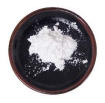
Soda is pure Sodium Bicarbonate, also called Bicarbonate of Soda (NaHCO3). It is
a white crystalline alkali which reacts by effervescing (fizzing) when it comes
into contact with acids, thus producing gasses, namely carbon dioxide. Because
of this chemical reaction, it is often used in fizzy drinks and antacid remedies
and it's precisely this reaction which facilitates the rising action in baked
goods.
Baking
Powder is more complex. It is composite of Sodium Bicarbonate (baking soda), one
or more acid salts such as Cream of Tartar (Tartaric Acid), Sodium Aluminium
Sulphate, Calcium Acid Phosphate plus a drying agent such as cornflour and the
exact mix determines whether it is "Single" or "Double"
acting. The difference between baking soda, single and double acting baking
powders, is when the chemical reactions actually take place, and is explained
below. However, the rising principal is the same in that a chemical reaction
produces carbon dioxide bubbles which expand through the cooking mixture.
What's
the difference between baking powder and baking soda ?
When
using baking soda, the mixture to which it is being added must contain some sort
of acid, often in the form of honey, molasses, brown sugar, sour cream, yoghurt,
cocoa, citrus juice or fruits. The chemical reaction takes place as soon as it
is added to the acid ingredient in the mixing bowl. This means you have to work
swiftly and get the mixture into the oven as soon as possible before the carbon
dioxide starts to dissipate, which they will quite quickly. (Think back to those
fizzy drinks once they've been poured into a glass - that initial burst of fizz
soon dies down to a little murmur).
When
using "Single Acting" baking powder, the chemical reaction,
once again, takes place in the bowl at the mixing stage, with the catalyst being
any liquid as opposed to an acid, so the same applies as to the speed at which
you get the mixture into the oven. Remember, the acid is already present in the
baking powder usually in the form of Cream of Tartar: it just needs to be
triggered off by the addition of moisture (water, milk etc).
"Double
Acting" baking powder adds another dimension. Not only does it start
reacting in the bowl as with baking soda and "single acting" baking
powder, but it also reacts a second time when it is cooked. This is achieved by
the addition of slower reacting acids to the single acting baking powder, which
hardly react at room temperature. These only become active once they achieve
higher temperatures. So it has a double action - once when subjected to moisture
in the bowl and once when subjected to heat in the oven. This quality means that
the rush to mix and get it into the oven is avoided, which is especially useful
if there are many ingredients which need thorough blending.
History
of baking powder
Food
historians believe the use of baking soda dates back to ancient civilization and
it is perhaps this age-old use of it which has prevented its demise as a
chemical additive.
Until
the late 1700's, yeast was the main leavening ingredient used. However once it
became widely accepted that bicarbonate of soda would create carbon dioxide gas
in the presence of certain acids, housewives began making their own chemical
leavening. Although the rising process was faster, it was a little hit and miss
due to the majority of the leavening gases being released in the bowl (at the
bench stage).
|
|


 One
of the oldest usages of baking powder/soda is in the making of Soda Bread which
is widely associated with Ireland. This is a leavened bread which, because of
the use of baking soda/powder rather than yeast can be very quickly made cutting
out the need for heavy kneading or proving time. This makes up for the fact that
it doesn't keep fresh for very long.
One
of the oldest usages of baking powder/soda is in the making of Soda Bread which
is widely associated with Ireland. This is a leavened bread which, because of
the use of baking soda/powder rather than yeast can be very quickly made cutting
out the need for heavy kneading or proving time. This makes up for the fact that
it doesn't keep fresh for very long.